
Razvoj ekološki prihvatljivog mobilnog postrojenja za regeneraciju otpadnih voda iz autoperionica Naučni rad
Bočna strana članka
Glavni sadržaj članka
Apstrakt
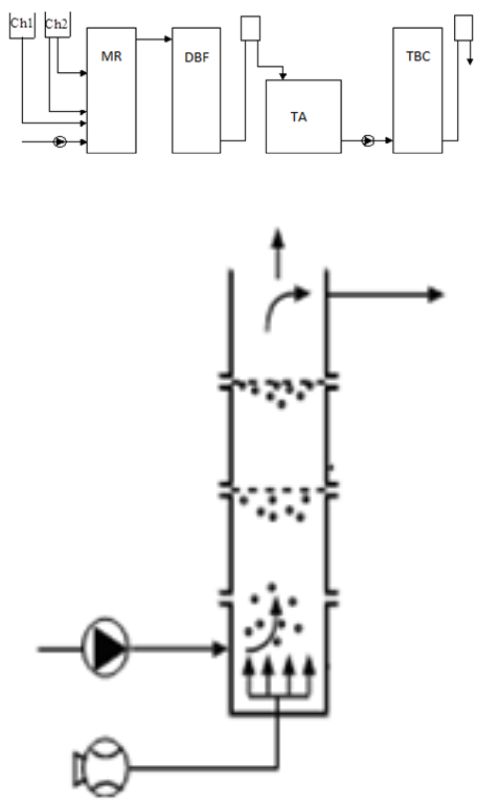
Stalni porast broja vozila na globalnom nivou negativno utiče na održivi razvoj zbog povećane potrošnje energije, buke i zagađenja vazduha, kao i povećane potrošnje vode koja se koristi za pranje vozila. Dominantni postprodajni servis u automobilskom sektoru je pranje automobila. Ako bi se otpadna voda iz autoperionica mogla ponovo koristiti u procesu pranja vozila, umesto sveže vode, mogla bi se značajno smanjiti potrošnja sveže vode. Kako bi se postigao ovaj cilj, neophodno je implementirati sisteme za prečišćavanje otpadnih voda „na mestu nastanka“ tj. u autoperionicama. U ovom istraživanju razvijeno je novo Pilot postrojenje za tretman, „na mestu nastanka“, otpadnih voda generisanih pranjem vozila u autoperionicama. Ovo pilot postrojenje predstavlja kombinaciju više metoda. Sastoji se od tri inovativna modula: višenamenskog reaktora (za koagulaciju/flotaciju, aeraciju/oksidaciju), filtera sa nasutim slojem (za filtraciju) i koalescera (za koalescentnu filtraciju). U svim ovim modulima materijali od kojih su formirani nasuti slojevi su izrazito laki (ekspandirani polistiren (EPS) i poliuretan (PU)), stoga je za njihovo pranje potrebna energija značajno niža nego kada je upitanju pesak koji se najčešće koristi kao filterski sloj. Pilot postrojenje ima jednostavnu konstrukciju i malu težinu, tako da se lako može premeštati po potrebi. Ovo novo razvijeno postrojenje pokazalo je veoma visoku efikasnost smanjenja HPK-a, kao i efikasnost uklanjanja suspendovanih materija i ulja, što ukazuje na njegov visok potencijal za rekuperaciji vode u autoperionicama.
Detalji članka
Broj časopisa
Rubrika

Ovaj rad je pod Creative Commons Aуторство-Nekomercijalno-Bez prerade 4.0 Internacionalna licenca.
Kada je rukopis prihvaćen za objavlјivanje, autori prenose autorska prava na izdavača. U slučaju da rukopis ne bude prihvaćen za štampu u časopisu, autori zadržavaju sva prava.
Na izdavača se prenose sledeća prava na rukopis, uklјučujući i dodatne materijale, i sve delove, izvode ili elemente rukopisa:
- pravo da reprodukuje i distribuira rukopis u štampanom obliku, uklјučujući i štampanje na zahtev;
- pravo na štampanje probnih primeraka, reprint i specijalnih izdanja rukopisa;
- pravo da rukopis prevede na druge jezike;
- pravo da rukopis reprodukuje koristeći fotomehanička ili slična sredstva, uklјučujući, ali ne ograničavajući se na fotokopiranje, i pravo da distribuira ove kopije;
- pravo da rukopis reprodukuje i distribuira elektronski ili optički koristeći sve nosioce podataka ili medija za pohranjivanje, a naročito u mašinski čitlјivoj/digitalizovanoj formi na nosačima podataka kao što su hard disk, CD-ROM, DVD, Blu-ray Disc (BD), mini disk, trake sa podacima, i pravo da reprodukuje i distribuira rukopis sa tih prenosnika podataka;
- pravo da sačuva rukopis u bazama podataka, uklјučujući i onlajn baze podataka, kao i pravo prenosa rukopisa u svim tehničkim sistemima i režimima;
- pravo da rukopis učini dostupnim javnosti ili zatvorenim grupama korisnika na osnovu pojedinačnih zahteva za upotrebu na monitoru ili drugim čitačima (uklјučujući i čitače elektonskih knjiga), i u štampanoj formi za korisnike, bilo putem interneta, onlajn servisa, ili putem internih ili eksternih mreža.
Kako citirati




Funding data
-
Ministarstvo Prosvete, Nauke i Tehnološkog Razvoja
Grant numbers 451-03-65/2024-03/200156
Reference
Kuan WH, Hu CY, Ke LW, Wu JM. A Review of On-Site Carwash Wastewater Treatment. Sustainability 2022; 14(10): 5764. https://doi.org/10.3390/su14105764
Monney I, Buamah R, Donkor EA, Etuaful R, Nota HK, Ijzer H. Treating waste with waste: The potential of synthesized alum from bauxite waste for treating car wash wastewater for reuse. Environ Sci Pollut Res. 2019; 26(13): 12755-1264. https://doi.org/10.1007/s11356-019-04730-0
Ghaly AE, Samir Mahmoud N, Ibrahim MM, Mostafa EA, Abdelrahman et al. Water Use, Wastewater Characteristics, Best Management Practices and Reclaimed Water Criteria in the Carwash Industry. Int J Biopro Biotechnol Adv. 2021; 7(1): 240-261. https://www.researchgate.net/publication/351269422_Water_Use_Wastewater_Characteristics_Best_Management_Practices_and_Reclaimed_Water_Criteria_in_the_Carwash_Industry_A_Review
Shifflett A. Five factors of carwash cleaning. Operation and Management, Carwash News, https://www.carwash.com/5- factors-carwash-cleaning/ Accessed on Decembar 5, 2023
Monney I, Donkor EA, Buamah A Clean vehicle, polluted waters: Empirical estimates of water consumption and pollution loads of the carwash industry. Heliyon. 2020; 6(5): e03952. https://doi.org/10.1016/j.heliyon.2020.e03952
Torkashvand, J.; Farzadkia, M.; Younesi, S.; Gholami, M. A systematic review on membrane technology for carwash wastewater treatment: Efficiency and limitations. Desalin Water Treat. 2021; 217: 31-41. https://doi.org/10.5004/dwt.2021.26534
Sarmadi M, Foroughi M, Saleh HN, Sanaei D, Amin, Zarei A, Ghahrchi M, Bazrafshan E. Efficient technologies for carwash wastewater treatment: a systematic review, Environ Sci Poll Res. 2020; 27: 34823-34839. https://doi.org/10.1007/s11356-020-09741-w
Zaneti R, Etchepare R, Rubio J. Car wash wastewater reclamation. Full-scale application and upcoming features. Resour Conserv Recycl. 2011; 55(11): 953-939. https://doi.org/10.1016/j.resconrec.2011.05.002
Al-Odwani A, Ahmed M, Bou-Hamad S. Carwash water reclamation in Kuwait. Desalination. 2007; 206(1-3): 17-28. https://doi.org/10.1016/j.desal.2006.03.560
Lau WJ, Ismail AF, Firdaus S. Car wash industry in Malaysia: Treatment of car wash effluent using ultrafiltration and nanofiltration membranes. Sep Purif Technol. 2013; 104:26-31. https://doi.org/10.1016/j.seppur.2012.11.012
Zaneti R, Etchepare R, Rubio J. More environmentally friendly vehicle washes: Water reclamation. J Clean Prod. 2012; 37: 115-124. https://doi.org/10.1016/j.jclepro.2012.06.017
Espinoza-Montero PJ, Martínez-Huitle CA, Loor-Urgilés LD. Technologies employed for carwash wastewater recovery. J Clean Prod. 2023; 401 :136722. https://doi.org/10.1016/j.jclepro.2023.136722
Bhatti ZA, Mahmood Q, Raja IA, Malik AH, Khan MS, Wu D. Chemical oxidation of carwash industry wastewater as an effort to decrease water pollution. Phys Chem Earth. 2011; 36(9-11):465-469. https://doi.org/10.1016/j.pce.2010.03.022
Zaneti RN, Etchepare R, Rubio J. Car wash wastewater treatment and water reuse - A case study. Water Sci Technol. 2013; 67(1): 82-88. https://doi.org/10.2166/wst.2012.492
Pintilie L, Torres CM, Teodosiu C, Castells F. Urban wastewater reclamation for industrial reuse: An LCA case study. J Clean Prod. 2016; 139: 1-14. https://doi.org/10.1016/j.jclepro.2016.07.209
Torkashvand J, Pasalari H, Gholami M, Younesi S, Oskoei V, Farzadkia M. On-site carwash wastewater treatment and reuse: a systematic review. Int J Environ Anal Chem. 2022; 102(15): 3613-3627. https://doi.org/10.1080/03067319.2020.1772773
Rodriguez Boluarte IA, Andersen M, Pramanik BK, Chang CY, Bagshaw S, Farago L, Jegatheesan V, Shu L. Reuse of car wash wastewater by chemical coagulation and membrane bioreactor treatment processes. Int Biodeterior Biodegrad. 2016; 113: 44-48. https://doi.org/10.1016/j.ibiod.2016.01.017
Brown, C. Water Conservation in the Professional Car Wash Industry. Report for International Car Wash Association, Washington DC, USA, .2000. https://www.carwash.org/%20operatorinformation/research/Pages/EnvironmentalReports.aspx Accessed on July 2023
Sarmadi M, Zarei AA, Ghahrchi M, Sepehrnia B, Meshkinian A, Moein H, Nakhaei S, Bazrafshan E. Carwash wastewater characteristics-a systematic review study. Desalination Water Treat. 2021; 225: 112-148. https://doi.org/10.5004/dwt.2021.26972
Hu, C.-Y.; Kuan, W.-H.; Ke, L.-W.; Wu, J.-M. A Study of Car Wash Wastewater Treatment by Cyclo-Flow Filtration. Water. 2022; 14, 1476. https://doi.org/10.3390/w14091476
Bazrafshan E, Kord Mostafapoor F, Soori MM, Hossein Mahvi A. Application of Combined Chemical Coagulation and Electro-Coagulation Process for Carwash Wastewater Treatment, Fresenius Environ Bull. 2012; 21(9a) 2694-2701 https://www.researchgate.net/publication/234719709_Application_of_combined_chemical_coagulation_and_electrocoagulation_process_to_carwash_wastewater_treatment
Boussu K., Kindts C., Vandecasteele C., Van der Bruggen B., Applicability of nanofiltration in the carwash industry, Sep Purif Technol. 2007; 54(2): 139-146 https://doi.org/10.1016/j.seppur.2006.08.024
N. Abdullah, N. Yusof, W.J. Lau, J. Jaafar, A.F. Ismail, Recent trends of heavy metal removal from water/wastewater by membrane technologies, J Ind Eng Chem. 2019; 76: 17-38 https://doi.org/10.1016/j.seppur.2023.125707
Gryta M, Wozniak P, Application of polypropylene microfiltration membranes for separation of wastewater from car wash Sep Purif Technolo. 2024; 331: 125707. https://doi.org/10.1016/j.seppur.2023.125707
Veit, MT, Novais ÍGV, Juchen PT, Trevisani Juchen P, Moreno Palácio S, da Cunha Gonçalves G, Zanette JC. Automotive Wash Effluent Treatment Using Combined Process of Coagulation/Flocculation/Sedimentation–Adsorption. Water Air Soil Pollut. 2020; 231: 494. https://doi.org/10.1007/s11270-020-04862-x
Europe: Increase of water regulations car wash industry, https://www.waternewseurope.com/europe-increase-of-water-regulations-car-wash-industry/ Accessed on June 7, 2023
2017 European car wash consumer study, International Carwash Association. https://www.prowash.fi/wp-content/uploads/2017/11/ICA-European-Consumer-Study-2017.pdf Accessed on June 7, 2023
[Šećerov Sokolović R, Sokolović S, Govedarica D. Performance of expanded polystyrene particles in deep bed filtration. Sep Purif Technol. 2009; 68(2): 267-272. https://doi.org/10.1016/j.seppur.2009.05.019
Kostić MH, Sokolović D, Sokolović S, Laminger T, Kiralj A. The effect of fibre morphology on packing phenomena and bed properties in coalescers. Hem Ind. 2022; 76(4): 197-208. https://doi.org/10.2298/HEMIND211224016K
Šećerov Sokolović R, Sokolović S, Šević S. Oily water treatment using a new steady-state fiber-bed coalescer. J Hazard Mater. 2009; 162(1): 410-415. https://doi.org/10.1016/j.jhazmat.2008.05.054